
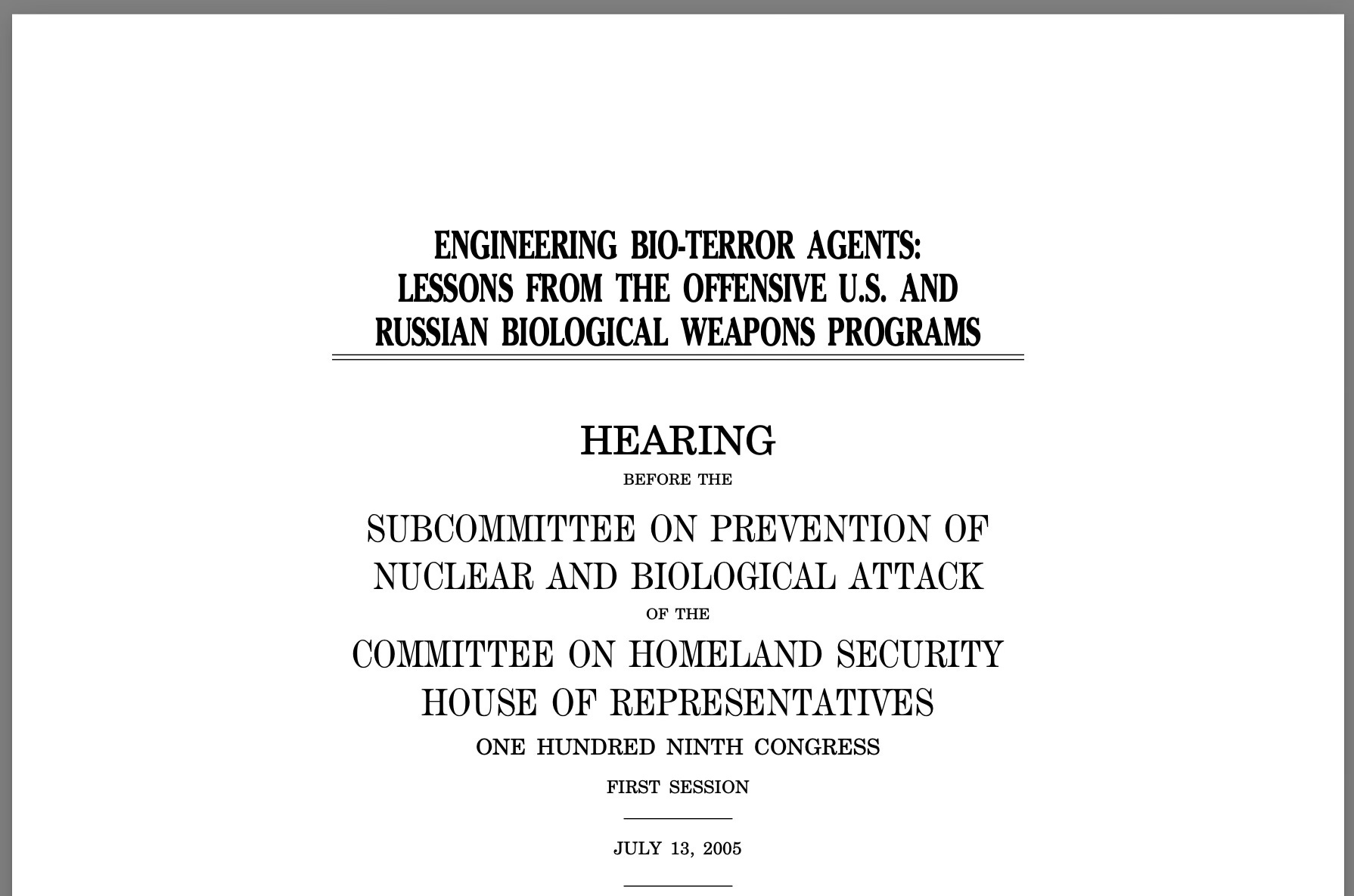
Michael Callahan's Testimony: "Engineering Bio-Terror Agents: Lessons from the Offensive U.S. and Russian Biological Weapons Programs," 2005.

Although it is clear that a “novel coronavirus” has never spread around the world via human-to-human transmission, and that the bulk of the deaths blamed on the alleged SARS2 virus during “COVID-19” were actually caused by hospital countermeasures and vaccines, the possibility that chemical/biological weapons hybrids, such as synthetic spike proteins developed by Peter Daszak, were deployed in various locations, cannot be dismissed.
The possibility that a person might intentionally use a synthetic chemical/biological weapons as a source of terror was discussed at length in 2005, not long after the 2001-2002 Anthrax attacks.
Here I present the entire testimony of Michael Callahan to the House of Representatives Committee on Homeland Security titled “Engineering Bio-Terror Agents: Lessons from the Offensive U.S. and Russian Biological Weapons Programs.”
Callahan’s testimony is one of many sources of information that I intend to include in a letter of opposition to Robert Malone’s proposal to use artificial intelligence to monitor the Biological Weapons Convention treaty.
The background of Robert Malone should be considered by those who are considering his proposal. Robert Malone, Michael Callahan, and others involved in current and former chemical/biological weapons programs in the United States are not trustworthy individuals, in my opinion.
Robert Malone spoke by phone with Michael Callahan in China in early January 2020 about the sequence of the alleged “Wuhan Seafood Market Virus.” Callahan was present in the Wuhan Central Hospital when patients allegedly fell sick from the mystery virus.
In my opinion, if a chemical and/or biological agent was deployed in Wuhan then Michael Callahan is the #1 suspect in the world.
Here, I’m just asking that you familiarize yourself with Callahan’s testimony.
I will list a few points that I find most interesting.
The tactics of a hypothetical bio-terrorist. “…if we model HVAC systems for indoor air attack and HVAC systems such as serving this room, allow for remote delivery of an agent, allowing chances for folks to get away.” … “So indoor air attack is absolutely critical.”
Ventilators. Like SARS2, SARS1 was a ventilator death event, although the death protocols didn’t spread as far. “By the time we returned to Hong Kong, there were 470 people on ventilators, and we were flying ventilators all around in Southeast Asia to try to shore up their health care capability, which, by the way, is a Western standard.”
Lab leaks. “These former (Russian) weapons scientists… call upon us across international cell lines to tell us that there has been a laboratory accident.”
Anthrax. Callahan was an expert on Anthrax and worked closely with the Russian scientists who weaponized it. I recall reading that the FBI excluded one federal government agency from their analysis of the source of the Anthrax used in the 2001-2002 Anthrax attacks in the United States. (Source needed).
In all the investigations of Congress on “the origins of COVID,” the involvement of Michael Callahan and Robert Malone has never been presented to the public.
With that I present the entire testimony of Michael Callahan to Congress in 2005.
https://irp.fas.org/congress/2005_hr/bioterror.pdf
STATEMENT OF DR. MICHAEL V. CALLAHAN, DIRECTOR, BIODEFENSE &
        MASS CASUALTY CARE, CIMIT/MASSACHUSETTS GENERAL

    Dr. Callahan. Thank you, Mr. Chairman, committee members.
    Like my predecessors, I can forego much of the testimony
with regard to the gravity of the threat, and focus with more
precision on some of the evolutions of the convening of
technology intent in the nooks and crannies of the planet where
these features and these factors co-exist.
    I will speak specifically with regard to three
applications. My first is, as a clinical infectious disease
doctor who works in the developing countries of the world in
management of the diseases caused by these agents, specifically
lassa fever, hemorrhoragic fever, Marlburg, Ebola, epidemics
from the past, cutaneous anthrax in northern Nigeria and other
places. These are listed in the testimony.
    My second contribution will shore up a lot of what
Dr. Alibek has said. I work extensively in the former
Soviet Union; I spend 30 percent of my time there. I spend that
exclusively at the bench top with former weapon scientists in
14 institutes tempering priorities to the Department of State’s
biological bioindustry initiative.
    A key point here that I would like to stress is that this
program, unlike any of the others, has used the biodefense
market and the biotechnology market of western nations to
create a market pull, to bring these former weapon scientists
to participate in part of the solution. And for this reason we
have had excellent access to these institutes. These former
weapons scientists, many of them aging, and many of them with
their children here in the United States receiving higher
education, call upon us across international cell lines to tell
us that there has been a laboratory accident, to tell us they
have a sick loved one in a Russian or former Soviet Union
hospital. So as a physician, we attend to them.
    As advocates and collaborators, we try to help them in
their education. And our statistics are quite good. Out of 177
currently engaged programs spanning 14 institutes, I will tell
you that the timeline for radical medical countermeasures to
the agents of bioterrorism number 11 percent. 11 percent of our
total portfolio in the Harvard system, and using the best of
our academic and biotechnology resources here in the United
States, has new answers coming out of the former Soviet Union
program. It is that which they prepared, they also mitigated
against. They had to consider blow back. They will perceive
that there was an offensive use capability by other nations
that were targeting them as well.
    So they have been thinking about unknown threat agents
being lodged at them for some time, and this is a paradigm
shift in the way they have developed their own science.
    The third and last application, which I will minimize for
the purposes of this testimony, is that the Department of
Homeland Security is embarking on a huge effort to bring
subject matter expertise and intelligence community members
together to chart a path. We are having great difficulties with
this because of arbitration and because of some of the
conflicts, and the fact that, quite frankly, our expertise is
not read in.
    I would like to contrast, as we go along the remaining
time, with the sharp distinctions with nuclear weapons. The
chairman and several others have already talked about these,
but I would like to crystallize these for you because it is
quite policy relevant.
    First and foremost, you need to understand that there are
seven critical ingredients to the manufacture of biological
weapons. I would like to go through them with just a couple
comments in each and try to help to develop good questioning
off of those.
    The first of these ingredients is access to agents. There
is a lot of attention being spent at the locks or freezers in
the former Soviet Union, this is important. It is what the
Defense Threat Reduction Agency’s priority goal is, and BII and
Department of State is doing that as well; it is not necessary,
though. I work in all of these countries and see these diseases
as a routine evolution of human ecology, and I have several of
the supporting materials that are in your folder that will talk
about that in some detail.
    We have over 200 laboratories in Subsaharan Africa from
where we have documented anthrax and plague from humans. And
these are laboratories which have the capability to isolate, to
purify and to amplify to these agents from all the background
infectious organisms. I will also note that many of these labs
are occurring in fundamental Islamic communities or are far
outside the scrutiny of western nations. They are, quite
literally, at the end of the path.
    Number two is that, in addition to the agents which are
easy to get and found in every country of concern to the United
States, is that there is a critical choke point, an actionable
choke point with regard to the reagents. There are several
reagents that are very helpful at amplifying these agents from
their background. Several reagents. It might be an antibody, it
might be a plasma that could be used for the construct of a
genetic organism, or with the advent evolving technologies, it
might be a small scale fermenter, an ager roller bottle system,
or an agent which helps to produce a high, dry powder which has
high loft efficiency. Reagents is a critical actionable place
to focus on.
    Expertise. Here I return our attention back to the former
Soviet Union program because it epitomizes this to some degree.
Expertise migrates much better than the technologies do. And
the experts from all the programs, and quite frankly, in ill-
intentioned, nefarious-minded, moderately-trained
microbiologists out of the European program cold return to
these western nations and reconvene all the necessary
ingredients of this technology and infrastructure to do covert
manufacture. I will note also that the reason why this is so
holoendemic in developing countries in the world is because the
veterinary communities produce their own pharmaceuticals
locally. They need anthrax to make an anthrax vaccine that is
used in northern Nigeria to treat the local economy, which is
on the hoof. So there is an economic force driving the
technologies of these developing and small-scale weapons as
well.
    Technology also contributes in a meaningful way to the
reconvening--remodeling really--of old-style, traditional
biological weapons, such as those that were found in the U.S.
program prior to its dissolution in the early 1970s. You can
take an old agent, an anthrax spore preparation, and you can
modernize it, and this increases its magnitude and its ponderal
impact, its impact upon the human populations. This is depicted
in my third handout, which talks about, at one magnitude,
reduction in the number of spores that you need based on the
incorporation of modern immunologic principles and the use of a
single new technology which became available in 2002.
    Beyond expertise and technology, I will end quickly with
some of the small points. One is budget. In our laboratory
modeling exercises of small-scale biological weapons, we can
produce 14 million lethal doses of anthrax as a model agent for
a reagent cost of 36 pounds British Sterling. That is the
reagent cost, that is not salaries. And this is done. It is not
a theoretical laboratory modeling exercise, it has been done
with the surrogates. It was mapped very carefully. It has an
Excel spreadsheet that goes with it, and a list of reagents and
inventories.
    It is also important to note that the people who
participated in that exercise used all open source information,
they used the U.S. Patent Office and they used out of print
microbiology textbooks. It is a scary incredible thing, and it
is not just theoretical, it has already been capitalized both
in laboratory modeling and in actual experience. I refer you
back to the intelligence community’s information on the
American anthrax attack in 2001, which we won’t discuss here.
    So after the budget, finishing up, production capability. I
will just remind you--and this reflects the first point about
the holoendemic nature of these laboratories is that you need a
covert production capability. With the modern technologies,
these laboratories are downsized. The laboratory model that was
used to produce that anthrax biological weapon was 200 square
feet, had a capital infrastructure cost of about $220,000, and
the graduate students were not salaried, so there were some
cost benefits in there as well.
    What is so often overlooked in our homeland security threat
analysis programs is that skilled research capital, even
terrorist capital, needs to be preserved. So another choke
point is to focus critically on the protection of terrorists
while they are producing these agents. While biological
containment, the laboratory equipment that you have that
protects your workers from being infected can be improvised not
at the highest level that is needed for aerosolized agents that
are highly dangerous pathogens.
    So here we look for the hypervaccined individual, and we
look for things such as consistent antibiotic immuno
suppression, which has been used in other programs as well.
    My summation is short because it is made easy by colleagues
here. The traditional weapons exist; they are very possible,
they are very plausible, they have been modelled extensively by
our European partners. The agents, the technologies are all
preexisting. And one of the tragic benefits is that as we
develop benefits in modern health care and modern technology,
which serve us well, they have a dark side, they have a down
side. And it is these same technologies which have dramatically
increased the efficacy and the efficiency of killing of these
threat agents.
    I will stop there, and I look forward to your questions.
    [The statement of Dr. Callahan follows:]

             Prepared Statement of Dr. Michael V. Callahan

    Mr. Chairman, distinguished Members, it is an honor to appear
before you to present information on the threat of traditional and
next-generation biological weapons. My perspective is derived from
experiences as a tropical medicine physician who studies and treats the
diseases caused by these agents, from experiences working with former
biological weapon scientists in Russia, and threat assessment
activities on behalf of the Department of Homeland Security’s National
Bioterrorism Analysis and Countermeasures Center (NBACC).
    I am a staff physician in the Division of Infectious Diseases at
Massachusetts General Hospital in Boston, Massachusetts, and the
Director of Biological Threat Defense at the Center for Integration of
Medicine and Innovative Technology (CIMIT). CIMIT is a multi-
institution, non-profit research organization funded by the U.S.
Government to identify near-term solutions for critical military and
civilian medical problems. Since January 2002, I have also worked with
the U.S. Department of State, in particular with the Bio-Industry
Initiative (BII), a program which uses the U.S. biotechnology market
and academic collaborations to redirect former Soviet biological
weapons scientists to peaceful, sustainable medical research. Prior to
this position I was on faculty at the Center for International Health
at Boston University where I served as clinical investigator for
tropical medicine research projects in sub-Saharan Africa. I currently
maintain tropical disease research activities in five developing
countries, which is pertinent to the discussion below. Since the
October 2001 anthrax attack, I have worked with biological terrorism
working groups from the National Academy of Science, the Department of
Defense, and the Department of Homeland Security. My focus areas are
risk analysis of small scale biological weapon production, and
consequence management following mass-casualty infections and
poisonings.
    This subcommittee has asked that I provide some perspective on the
threat of engineered biological weapons. As there is considerable
debate about several aspects of biological weapons, I have attempted to
support this testimony with photographs from the field and from
laboratory modeling activities. I will emphasize here that I am not an
expert on the former U.S. biological weapons program that was disbanded
in 1971. I also understand that Dr. Alibek will provide testimony on
the Soviet biological weapons program under Biopreparat. My reference
to the FSU (Former Soviet Union) program will therefore, be restricted
to information gained from ongoing research collaborations with ex-
biological weapons scientists from 10 Russian institutes. It should be
emphasized that my experiences helping BII to develop drug and vaccine
commercialization opportunities for former weapons scientists have
resulted in access to several institutions previously closed to
westerners (Figure 1). Further transparency is gained, perhaps
ironically, by relationships forged from my medical care of former
weapons scientists and their family members, and on occasion, emergency
medical consultation to infections resulting from laboratory accidents.
Finally, it is probably relevant that my experiences conducting
clinical research in remote African and Asian locales have sensitized
me to some of the challenges a terrorist lab would encounter when
attempting to make a biological weapon in an austere environment
(Figure 2).

    What is our current understanding of engineered biological weapons?
    Most experts agree that biological weapons are the original weapons
of mass destruction. Throughout history, the overwhelming majority of
biological weapons were used in a crude form. For example the first
recorded use of biological agents was in 1346 when the Tartars
catapulted plague-ridden corpses into the city of Kafka. In more recent
history, a branch of the Japanese army, Unit 731, reportedly dropped
plague-infected fleas in ceramic bomblets over cities in China in WWII,
which likely accounts for unusual changes in the epidemiology of this
disease in several regions. Prior to the genomic revolution of the last
two decades, laboratories in several countries worked with variable
success to stabilize infectious microorganisms and toxins so that they
could be stored and deployed with greater efficiency and
predictability. The advent of molecular biology, advances in our
understanding of infectious diseases and immune regulation, and
advances in micro-particle engineering and micro-encapsulation have all
resulted in technologies that can be used to either advance the
properties of biological weapons or as countermeasures to protect
against them.
    Past military interest in biological weapons was driven by the
realization that a comparatively small investment is required to make a
tactical weapon capable of killing a large number of enemies. In rare
cases, military weapons programs considered biological weapons as part
of strategic campaigns. The interest in using biological toxins and
infectious microorganisms as weapons was also driven by characteristics
of the agents themselves. For example, in contrast with other munitions
such as nuclear, chemical and conventional high explosives, only
biological weapons are self-replicating. Moreover, these agents can be
scaled-up from seed stock to a full stockpile on short notice and with
considerably less engineering, manufacturing, capital investment and
production signature than would be produced by nuclear or chemical
weapons. A related characteristic is that biological weapons can be
covertly transported as either minute quantities or in a form that
leaves no signature, thus allowing the agents to cross international
borders and be produced behind enemy lines. Military strategists also
noted that only biological weapons could be successfully deployed
without detection, a desirable characteristic if attribution is to be
avoided. By the time clinical symptoms would appear, those that
deployed the weapon would be many hours or days distant. Most
ominously, and in stark contrast to chemical and nuclear weapons,
contagious biological weapons such as killer influenza and smallpox,
have the unique capacity to cause casualties far beyond the immediate
impact zone.

    Biological Weapons and Terrorism
    Many of the characteristics that make biological weapons attractive
to past military programs also make them desirable to the terrorist.
Fortunately, the convening of biological weapon capability and
terrorist intent has not as yet resulted in a mass-casualty incident.
Unfortunately, several disquieting observations of the October 2001
anthrax attack using the U.S. mail system merit emphasis. First, the
attack illustrated that advanced expertise had readily been exploited
by a bioterrorist; the preparation in the Daschle letter contained
extraordinarily high concentrations of purified endospores. Second, the
spore preparation was coated with an incipient which helped retard
electrostatic attraction, thus increasing aerosolization of the agent.
Third, the choice of the near-ubiquitous Ames strain, combined with the
absence of forensic details in either the agent or the letters,
indicate that the terrorist is scientifically informed, wary of
detection and extremely dangerous.
    I use this well-publicized case to demonstrate that from the
perspective of the terrorist, biological weapons are likely to be the
optimal choice for inducing terror. As a practical point, the terrorist
is likely to be attracted to any means which causes maximal disruption,
terror and loss of confidence while using the minimal amount of skilled
personnel, specialized resources and financial investment. For example,
the skills required for bioweapon manufacture may be derived from
manufacturing practices that use similar technologies such as the
fermentative and agricultural sciences, vaccine manufacture, potable
water treatment and environmental microbiology. In this regard,
bioweapons offer specific advantages for covert manufacture by the
terrorist:
        1. The agent may be produced using equipment designed for other
        peaceful purposes (so called `dual use’).
        2. Production requires minimal space and time, a characteristic
        that is increasing with modern technology.
        3. Unlike any other weapon, infectious microorganisms are self-
        perpetuating, and therefore may be propagated among the
        terrorist groups or cells.
        4. Several agents can cause casualties beyond those originally
        infected.
    5. When human assets need to be preserved, these weapons allow the
perpetrator to escape detection.
    From the perspective of the threat analyst, there are 7 overlapping
conditions that need to be present for a terrorist group to produce an
effective biological weapon. Failure to meet any of the following
conditions can thwart an attempt at weapons production. These
conditions are consolidated from consensus opinion of different U.S.
Government working groups, by CIMIT’s modeling activities and from
field experiences working with over one hundred laboratories in
Southeast Asia and sub-Saharan Africa (reference Figure 1: a clinical
infectious disease laboratory in rural northern Nigeria. The laboratory
technician and I are holding up red blood cell agar plates containing
the non-hemolytic Bacillus anthracis which was isolated from the skin
lesion on a local goat herdsman. In this region, estimates of 15-40
cases of cutaneous anthrax are observed annually): the seven conditions
for biological weapon production are:
        1. Access to agent: this condition requires that the terrorist
        has the ability to isolate or procure the microorganism or
        biological toxin. Note that many threat agents are endemic in
        Neotropical regions of the globe, including all countries of
        concern to the U.S. Naturally-occurring infections resulting
        from these microorganisms are routinely encountered in domestic
        animals, as is the local expertise required to recognize these
        infections. Procurement can involve coercion, misrepresentation
        of intent, or illegal purchase from a former weapons program or
        strain collection.
        2. Reagents: this condition includes availability of factors
        required for successful biological isolation and amplification.
        Examples include specialized or improvised culture media,
        sporulation-inducers, and incipients to stabilize the agent or
        to improve purity.
        3. Expertise: technical know-how can be derived from other
        disciplines. In modeling studies stated knowledge gaps to
        weapons manufacture may be overcome using internet based
        literature and patent reviews, use of out of print texts, and
        identification of solutions from parallel scientific or
        manufacturing disciplines.
        4. Support technology: this category includes laboratory assets
        such as roller bottles, agar trays, fermentors, lyophilizers,
        egg incubators, cold storage capability, animal testing
        capability and biochemical test kits. The recent
        commercialization of an unnamed technology has dramatically
        simplified the challenges to manufacture of one bioweapon by
        allowing a less refined preparation to be used.
        5. Budget: in both resource rich and austere economies, the
        financial cost of procurement, laboratory consumables, animals
        and maintenance of laboratory operations is significant. In
        modeling studies, the anticipated budget required to complete
        all manufacture tasks posed a greater challenge to a minimally
        resourced terrorist group than did other tasks.
    6. Covert production: modeling for small scale anthrax suggests
that a small appropriately-equipped laboratory with a footprint of 250
ft2 would meet the production needs of a small scale spore weapon.
Although many agents can be purified and engineered in simple
microbiology laboratories (which are found worldwide), large scale
production, coating and stabilization would require a purpose-
designated facility.
    7. Laboratory Safety: skilled technicians require protection,
however the procurement of specialized safety equipment is closely
monitored. For this reason safety capability may be improvised, or lab
workers may be hyper-vaccinated and maintained on antimicrobial
prophylaxis to permit lower levels of containment to be used.
    What can the Former Soviet Union Weapons Program teach us about
Engineered biological weapons and bioterrorism?
    Recent terrorist attacks in Russia have prompted government actions
to protect against terrorism. However, an ethnically diverse
population, poor border controls, regional corruption, and the
continued conflict in Chechnya have all produced conditions that could
still result in a biological weapons attack by terrorists. According to
one Russian government official, ``In no other place do the microbes,
the expertise, the infrastructure co-exist in such close proximity with
terrorist groups and chaotic times’‘ (name omitted). In the last 2 yrs
the concern about terrorism has prompted new levels of disclosure and
cooperation between the Russian Federation and the United States. In
the last 2 years there have been 4 conferences in Moscow and St
Petersburg where prevention and response to bioterrorism was a major
topic. These conferences are important for a second reason in that they
provide a forum whereby the FSU scientists present previously unknown
countermeasures or vaccine strategies which were used to protect
production workers or government personnel from the USSR agents. Some
recently described technologies, such as non-specific immune enhancers
(immune modulators) have little precedence in Western biodefense and
are exciting new additions to the BII’s Advanced Vaccine and Drug
Development program.

    Traditional weapons programs
    Traditional biological weapon manufacture is best illustrated by
the former U.S., British and Soviet era production methods. In the
Soviet era program, simple methodologies such as microbial fermentation
were conducted on a grander scale. In two former production institutes
(Stepnogorsk and Berdsk) fermentors used to produce weapon strains were
many thousands of liters in volume, over two stories in height and
under continuous stringent environmental control.
    In these programs the kill efficiencies of the weapons were
increased by maximizing the number of viable microorganisms in the
final munition rather than focusing on engineering of the organisms
(which came later). SRCAM scientists recount that in the case of
anthrax, attention was focused on increasing fermentation and spore
production efficiency, and spore recovery using a number of methods
such as foam flotation. Other expertise was directed at improved
methods of milling to produce progressively smaller clusters of spores,
a condition for successful delivery and sequestration in the terminal
alveoli of the lung. By report, there were occasional production
misadventures where fermentation runs were contaminated by other
bacteria or anti-bacterial phages which destroyed the entire production
run.
    In the years since the end of the Russian program, our scientific
understanding of microbial metabolism and the improved efficiency of
automated small scale fermentors have increased the amount of
vegetative bacteria that can be produced with minimal resources.
Parallel sciences, such as biological insecticides which use bacterial
spores afor peaceful purposes, have provided clues to maximize yield in
a small laboratory. Perhaps most disturbing is the growing availability
of small scale, autonomous operating fermentation systems which reduce
the need for skilled technicians and a complex support infrastructure
(e.g. Bioflo IV Fermentor, New Brunswick, Inc). These systems are
becoming more common in agricultural regions of Africa.
    When considered as a whole, traditional weapons technologies with
alterations rather than genetic engineering are the most likely to be
employed by a moderately resourced, moderately skilled terrorist group.
There are many open sources and skilled personnel who can provide
guidance to help assemble the critical components necessary for weapons
development. Potentially, a former weapons scientist from Stepnogorsk
could travel to country in the Middle East and reconvene a weapons
capability from available veterinary, agricultural and clinical
microbiology resources. For Middle Eastern countries, the easiest
solution would be to isolate a virulent epizoonotic pathogen from a
local infected animal. These scientists need not bring anything with
them but their expertise.
    To summarize, efforts to prevent traditional biological weapon
production should include efforts to prevent migration of skilled
personnel to hostile groups. Additional measures for prevention of
weapons development include tight scrutiny of international
collaborations and tracking the importation of small scale bacterial
growth systems and close human and animal surveillance efforts to
detect infections resulting from deficits in the safety of a weapons
laboratory.

    Next-generation Biological Weapons
    Next-generation biological weapons are those that benefit from new
technologies, those made from previously unknown infectious agents or
biological toxins, and those where a traditional agent is dramatically
altered by the addition of a high-tech capability. One concept that is
central to discussions of enhanced virulence biological weapons is that
the same open source methodologies that advance our ability to improve
upon human health may also be commandeered for nefarious purposes. A
second point is that traditional biological weapons such as those
produced in military weapons programs can be modernized to achieve new
levels of lethality. The following case is used to illustrate this
point.
    In the former U.S. weapons program, estimates were made about the
number of anthrax spores required for an LD50 (dose required to kill
50% of a population) and LD90 (dose required to kill 90% of a
population). Extrapolations from these estimates indicate that between
8,000-10,000 spores would be required for infection. These estimates
are likely accurate for the anthrax strains used in the pre-1971
program. Unfortunately, in recent years there have been dramatic
advances in the modeling of airflow in the human lung which in turn has
driven the field of aerosolized drug and vaccine delivery. In the last
8 years, particle physicists and pulmonary scientists have worked
together to improve the efficiency with which drugs reach the alveoli
of the lung, which is also the preferred target for the aerosolized
anthrax spore. A parallel advancement has occurred in the field of
immunology where new organic coatings have been invented which
dramatically increase the uptake of particles by the specialized cells
in the alveoli. Unfortunately these cells are also responsible for
providing the anthrax bacillus with a protected beachhead for
replication. The result is that two unrelated technologies, a method
for generating small drug and vaccine aerosols, and the development of
a specialized coating, are responsible for dramatically reducing the
number of spores required to produce a successful infection. (Figure 3
depicts the methods used to produce a coated anti-floculated spore as
well as the calculated reduction in spore concentration required for
infecting 80,000 people in a large city. Select steps and information
omitted for this testimony)
    Genetic engineering has also played a role in altering the
capability of biological weapons. Toward the end of the Soviet
biological weapons program an effort had been made to make several
agents resistant to antibiotics. Much of this work was done using
techniques considered inefficient by today’s standards. Biological
weapon analysts with expertise in molecular biology believe that drug
resistant biological weapons are a moderate probability event that
could have disastrous consequences. The reasons for this are based in
the current health care impact of antibiotic-resistant microorganisms,
which are arising as a consequence of indiscriminate antibiotic use.
What is not clear is how likely it is that a biological weapons
scientist could make a threat agent that is both highly resistant and
highly virulent. Such balanced capability would require that the
organism be continuously tested against animals to maintain virulence.
Thus in this case, the requirements needed to engineer-in genes for
antibiotic resistance might also require an attendant investment to
insure that the agent remained highly pathogenic.
    Next generation biological weapons may also be engineered using
negative selection techniques. In this case antigens to which the
patient’s immune response is directed are removed from the biological
weapon. In worse case scenarios, the terrorist might eliminate the
antigen on a bacteria, virus or toxin that was used as the basis for a
government vaccine. If the patient was exposed to one of these antigen-
negative biological weapons, they would be immunologically naive
resulting in more severe infection and/or death. These types of agents
are known as vaccine-evading biological weapons. Unfortunately, the
concept that such agents could be developed is dramatically illustrated
by the need for new vaccines to protect against circulating strains of
influenza A/H3N2.
    Next-generation biological weapons also include the engineering-in
of properties that influence the ability of the body to mount an immune
response. In recent years, there have been several publications which
have demonstrated this concept to biodefense scientists and
potentially, to any terrorist with internet access. One of the most
disquieting publication in 2002 described a method for defeating
vaccine-protected animals by inserting a gene which down-regulated the
immune system resulting in overwhelming infection and depth (reference
provided upon request). Another publication which will appear in an
international journal this September describes a methodology which
single-handedly solves two separate challenges facing a biological
terrorist: how to move virulence genes from one agent to another, and
how to store a biological weapon without depending on freezers and
liquid nitrogen (reference provided upon request).
    One of the most ominous of engineering feats that could be used by
biological weapon scientists is to induce host tropism into the agent,
whereby the agent is altered to favor infection of a specific human
genotype. This seemingly far-fetched concept is already demonstrated by
certain tropical parasite infections that cause more significant
infections and sequelae in certain ethnic groups.
    The efforts of the biological terrorist to produce a new threat
agent can also be assisted by natural events. This scenario is best
illustrated by current experience with avian influenza in Southeast
Asia. Since 1998, the pathogenicity of this bird virus has increased as
has its ability to infect the upper respiratory systems of pigs and
humans. The result is that infected patients are exposed to a novel,
highly pathogenic respiratory virus to which their immune system is
completely naive. The danger of this event is exacerbated by the fact
that influenza, unlike anthrax, can be transmitted from person to
person.
    I will summarize this written testimony by reaffirming the concept
that the dark science of biological weapon design and manufacture
parallels that of the health sciences and the cross mixed disciplines
of modern technology. Potential advances in biological weapon lethality
will in part be the byproduct of peaceful scientific progress. So,
until the time when there are no more terrorists, the U.S. Government
and the American people will depend on the scientific leaders of their
field to identify any potential dark side aspect to every achievement
    Again, I appreciate the opportunity to present this information
before the Committee. I shall be happy to answer your questions and to
provide additional documentation supporting the material presented.

[GRAPHIC] [TIFF OMITTED] T7222.001

[GRAPHIC] [TIFF OMITTED] T7222.002

[GRAPHIC] [TIFF OMITTED] T7222.003
Dr. Callahan, are we getting good access to the labs in the
former Soviet Union?
Dr. Callahan. Yes. And what is also critical to know is
that Dr. Alibek is referring to the production capability,
which is really 4 to 6 institutions, the Croftburg, Stavuguart,
and several of the others. But the Russians choose those
programs--and Ken can talk about this in great detail--based on
the return on the investment, on the capital investment, some
large fermentation capability involving multi-story, tens of
thousands of liter fermenters were used. The Russians also had
a B plan, though. Those were the very expensive high efficiency
agents that sat on bench tops, and these--the pace to improve
the efficiency of these agents remained in single scientific
labs. And this is one of our critical focus areas is going
after the former Soviet Union B plans. Short answer, yes, there
is multiple levels of weaponization, there were multiple levels
of technical development, and all have benefited from the
evolution of technology and their migration across
international borders.Dr. Callahan. I also need to add in here, working the Avian
Influenza Syndrome and surveillance program throughout Asia, we
are critically concerned about Avian Flu. I understand Sue
Simonson has talked to you. We used the tippy top of the
international flu community to help understand how to mitigate
against this threat. It is a catastrophe. And one of the
biggest evidence of this is that the influenza R&D for
weaponization is occurring in small chicken farms throughout
southeast Asia; you can’t forget that. Second point is that the
co-infection between a normal circulating strain are current
H3N2 and an H5N1 is statistically extremely probable. And what
we see with the evolution of influenza in Southeast Asia, be it
southern China, Hong Kong, the Himalayan region, and we go and
see these patients and work with these collaborators, we are
finding it slightly different from each other. That is bad
news. That means it is not a single point transition, but it is
a virus trying to find its way. And this is a very important
point and is a live fire exercise for biological defense of
this country.Dr. Callahan. The sad misfortune is that vaccination
technology is as old as dinner, I mean, it is literally two
centuries old, and for that reason the technologies to
vaccinate and protect an underresourced biological weapons
scientist working in a remote lab are preexisting.
I will note, though, that vaccines have a certain amount of
efficacy. Our current vaccines are woefully inadequate, with
the exception of potentially the smallpox dry vac. Without
exception, our currently deployed stockpiles of vaccines are
less effective. We use these vaccines as clinical infectious
disease doctors protecting our people that go into harm’s way.
We are not very interested in their long-term efficacy because,
quite frankly, there is going to be the need for other care.
So choke points on vaccines are a difficult issue. One of
the ones that has shown up, though, in the laboratory modeling
though has not been control of the agents, has not been
tracking the vaccines, it has been tracking a critical recently
emerged technology. In this year alone, in the first 4 months
of 2005, there are 19 papers that have been produced which
provide heavy, excellent answers for the challenges facing a
biological weapon scientist working in the Khandalar cave. They
usually allow them to forego cold chain refrigeration to store
their agent. That way they could acquire genome in one place
and put it into an agent to be used for dissemination.
So certain technologies are a critical choke point. And Dr.
Brent can probably comment more on that, as can those that are
tracking technologies and migration around the planet, so I
will stop there.I think, Dr. Callahan, you have been very helpful to the
committee in providing what I would refer to as the seven
habits of highly effective bioterrorists. The seven
characteristics that you describe as sine qua non of terrorist
groups that might want to produce bioweapons, to what extent
would this phenomenon of the garage hacker, if you will, if it
is real, defeat our ability to rely on these seven
characteristics? I mean, would it really require the kind of
budget, for example--which is one of your seven factors that
presently it does--would we be able to drill down on these
preconditions to prevent terrorism, or do we need to rethink
it.
Dr. Callahan. Yes. Those are focus areas for interdiction,
both for the intelligence community and for those that are
monitoring migration technologies and agents. Using the garage
hacker as a term, I need to stress that the technologies are
now being downsized to the point where the laboratories operate
autonomously. Before the scientific community and the
biotechnology community was dependent on critical pieces of
hardware in other institutions, gene chip machines, PCR
machines, trial fermenters, and these sort of kept these
programs very integrated for biodefense, or the normal
construction of our understanding of clinical infectious
diseases. The problem now is that there is an incredible
community which is producing technologies, an entrepreneurial
community which is producing technologies for civilian peaceful
use that involved the propagation of infectious agents and
their byproducts that marry medicine and vaccines, biological
insecticides, fermentation sciences, endermatic control
systems, and basically countermeasure flocculents and
environmental mediation systems all use critical elements that
are downsized. Literally our 30 liter process fermenter weighs
130 pounds, it is easy to transport with two people.
So these systems are throughout Africa. We see them all the
time, they are a normal part of agricultural pesticide
generating systems.
There is a key point that I need to also instill on this,
it is that the biological technology revolution, if you compare
it to your analogy of the computer revolution, it is not 1965,
we are in the late 1980s and the speed is picking up. We are
consistently spending a lot of our attention looking at the
open source published literature, and it is outpacing the
Department of Homeland Security’s ability to do threat
assessment. We can’t read fast enough nor cross-train enough
for the infectious disease or molecular biologists at the pace
necessary to determine what is the threat.
So we are just picking up the big stuff, and we are
probably about a year behind. We have received several red
alerts this month alone for publications that will show up next
month.
And you mentioned, also, this interesting point about the
suicide biological weaponeer. What is missing in our calculus,
with the exception of the intelligence community’s
contribution, is terrorist intent and what they are willing to
do. And think of our situation, when we were responsible for
controlling the public health security of the homeland during
2003 SARS epidemic, and we have an international airline en
route from Hong Kong and we get an alert that there are two
SARS contacts on board. So what do we do? If we have that
alert, it is a normal public health problem, it is going to
inconvenience every passenger on that jet while we do contact
tracing, but imagine if the intent is different and there is no
alert. Imagine how that changes the response among civilian
groups. This has been modeled, not by the Americans, but by the
Europeans, looking at the American economy and the impact on
our financial centers. And for the reasons that are obvious in
an open source forum, we can’t go into the specifics, but it is
intent.
So an e-mail to The New York Times saying, hey, I have
already been there and done my coughing versus somebody that
you catch on the plane, these are very different responses to
basically the same biological threat, the preexisting live fire
and natural experience, someone with SARS coming to the U.S.
that we pick up at the borders, versus someone that doesn’t
want you to know.Dr. Callahan. I am intimately involved with the material
threat assessments and can tell you about their benefits and
their lessons. The key point here though is, if you step back
and look at it the way our former enemy looks at it, each of
these strategies is easy to defeat. We have vaccine-evading
biological weapons. We have detector-evading biological
munitions. These systems are currentlySec.
Mr. Dicks. So do we do nothing?
Dr. Callahan. Negative. What happens is, there needs to be
a paradigm shift with our approach to the problem.
Dr. Alibek actually has worked and has expertise in
nonspecific immunomodulators, the way you enhance immune
response in a way that will bolster nonspecific immunity.
It is absolutely critical to understand that you might not
get anthrax, you might get something that is anthrax-like. It
has the guts and the payload of the anthrax bacillus put inside
another spore. It will defeat our public health surveillance
capability because it won’t grow on the right plates in our
reference labs. It will defeat the clinical diagnostic criteria
because it may not show up correctly in the hospital labs, and
it will present, clinically, differences so that you don’t get
necrotic skin lesions in the injuries.
So, again, we need to sort of step back and think of an
integrated approach that involves all elements of our
scientific discipline, spanning molecular biology, but
certainly more terrorist intent and understanding the force and
futures that modulate the strategic thinking to make these
offensive agents.
They are agents of terrorism. They want to get away with
the crime, and they also want to be culpable and say, look what
we did to you.
Mr. Dicks. But is anybody doing that actually?
Dr. Callahan. Think of the subject matter that must have
been convened by Homeland Security through DHHS in part. What
happened is that we used an anthrax expert. We used a botulism
expert. We used a tularemia expert. These people are mono-bug
people. They have been working all their life with one agent
and their ability to think like a terrorist in a Kandahar cave
cannot be replicated by a well-resourced scientist in some
major academic or biotechnology institution.
We need to step back and produce a realistic premise for
the force and features which influence these technologies in
bringing them together for bad use. So we really need an
integrated plan. The detectors need to not detect a single
antigen on an anthrax spore, they need to detect difference in
change, rapid amplitude escalations we need for the unknown.
And quite frankly, this has a tremendous return for our public
health preparedness for avian influenza and the as yet unknown
infectious diseases that give me job security for next year.
Nature is working for me.Mr. Markey. Dr. Callahan, do you think that we have
adequate security around biohazard storage facilities in the
United States?
Dr. Callahan. Yes, I think they have dramatically improved
in recent years, but they are easily circumvented by the novel
engineering of a new agent. And getting a new anthrax strain
out of Texas, South Dakota or Maine, we can have a few in about
10 days.So national security and some of the other properties in
the world go hand-in-hand.
Dr. Callahan. I would comment only that the natural
experience of facing a threat agent that you don’t understand,
we haven’t done very well. If we think back about SARS, that
was using 2003 technology. It was using some of the most
resource-rich laboratories around the planet. It took 19 days
to actually isolate the specific genera of the organism, and
that came from an electronmicrograph of a patient’s lung.
By the time we returned to Hong Kong, there were 470 people
on ventilators, and we were flying ventilators all around in
Southeast Asia to try to shore up their health care capability,
which, by the way, is a Western standard.
So, to your first point, to mitigate against these events,
an unknown threat agent, we are going to do poorly based on
what our current success record has been with avian influenza
in the past, orthopox viruses in the past, particularly the
recent cow pox from several years ago, and SARS being a crystal
clear example of our capability when put on the line.
The second point is, DARPA has been mentioned, as has BII.
These two extremes of resources have not been capitalized on in
a major way. The reason why I will suggest to you that we need
a closer attention here to support the Homeland Security effort
is because BII in Russia is looking at countermeasures that
haven’t even been considered by the Western cognition, by the
American sort of way of thinking. Classic antibiotics and
vaccines for one bug, nonspecific immune enhancers and
bolstering the immunity of a population have some principles in
natural history and, of course, military history.
The last and final point is that DARPA is certainly one of
the convening arms for these technologies and needs to be
supported with subject matter expertise, it needs to be read in
and integrated.
This just raises a critical concern because imagine being
that biotechnology company that you are trying to entice with
biodefense dollars, and yet your antigen, the thing in the bug
that you are trying to block, needs to be classified because it
is so easy to circumvent it if you are a terrorist. So that is
not the way that science and certainly not the way basic
science infectious disease has operated.
So these are some of the dilemmas which are procedural,
which are policy relevant and involve all the basic science
community, which is intending to publish, as well as our
intelligence and medical intelligence communities.
Thank you.We heard testimony yesterday on BioShield, and I am
wondering, first, are we approaching BioShield in a manner that
the scientific community supports, or are we just putting money
out there and people are chasing the money? I hope you
understand what I am saying.
I will take any answer.
Dr. Callahan. Clearly, these are large appropriations and
large allocations, and they entice a lot of competitive grants.
The trouble is that the best of the experts are oftentimes
individual scientists in small laboratories and they are
largely disengaged from the system.
The second point is, there is a huge resource in the
biotechnology-for-profit sector. The best of the minds get
bought away from the academic centers. As opposed to the DHS
effort, it capitalizes heavily on the national labs, usually
driven by the need for security clearances and to put big
fences around things. The trouble is that those shops tend to
be single shops and they try to keep everybody else out.
If we are truly mission driven and we are truly trying to
get the best of the talent at the table, we need to step back a
little bit to a great review using the best of our review
capabilities out of NIAID, CDC, DARPA specifically, and
USAMRID, to find these agents that can really help us with
this.Also I am interested in what I understand was some mention
of broad spectrum antibiotics. Whoever would be best informed
on those subjects.
Dr. Callahan. I think that you are hitting a critical
point, which is that fairly moderate efficiency biological
weapons gain efficiency when kept contained. They also, if we
model HVAC systems for indoor air attack and HVAC systems such
as serving this room, allow for remote delivery of an agent,
allowing chances for folks to get away.
The third point, which is very much in evidence in the
community here, is that buildings tend to house a lot of the
same type of people, and if those are desirable targets, be it
military personnel, government officials, school kids, whoever,
you get a higher return. This is actually modern military
strategy, it falls into the CARVER-SHOCK analysis.
So indoor air attack is absolutely critical. The detectors
are woefully inadequate and the currently deployed ones all
have device-defeat capability with currently existing
technology. That is a fact.
Ms. Norton. Well, if that happened, let us say, in a subway
car, would you end up shutting down your entire subway system
for a long time just to decontaminate it? What would be the
consequences?
Dr. Callahan. The area denial consequences are vast. The
current projections right now, for example, if we have another
SARS event on an airplane, because that happened in Southeast
Asia, is, you don’t decontaminate the plane, you scrap it.
With subway systems, the amount of effort that would be
required to decontaminate those systems to allow for the return
of public confidence in those systems is so extraordinary, you
might call upon the cost of the Brentwood postal facility decon
as an example for that.Ms. Norton. And I take it, we don’t have any defense at the
moment against such an attack in a closed system such as a bus
or subway.
Dr. Brent. Well, with SARS, no.
Dr. Callahan. No, and the key point is the migration.
Remember, these are not conventional high explosive events,
neither are they really dirty bombs; but these materials,
particularly if infectious, but also in the case of anthrax
spores, they are going to migrate. So your contaminated zone,
how big a yellow circle you draw around the District of
Columbia, the city of Boston or New York, gets bigger and
bigger over time. And if these are infected patients, a
contagious disease such as killer flu or another agent like
that, then your problems have a tremendous magnitude.
Ms. Norton. So I take it the problem of infection is even
worse than the problem of death.
Dr. Callahan. Oh, absolutely. It is how big a ring you need
to treat. And also there are huge consequences to treatment.
There are several people in this room who have been on Cipro
for 2 months. That had a burden to them, and for clinical
infectious disease, we are realizing it now.Dr. Callahan, you talked about the 19 studies that have
come out this year, talking about the migration and movement of
these facilities. Would you expand on that?
Dr. Callahan. Can you restate the question?
Mr. Linder. You talked earlier about 19 studies you read
this year about the movement of some of these labs and the
migration of the expertise.
Dr. Callahan. Yes, and the tragedy is how difficult it is
to find a forum outside of Homeland Security and the
Intelligence Community to share that information. The reports
come in because they shore up the capability of remotely
operating terrorists, specifically for small-scale
laboratories.
Most of the reports have to do with the new methodology
which has been proposed by a well-intentioned group which is
thinking about another problem, the preservation of genomic
material being a specific example. Then what happens is, they
go ahead and put it out there, and because of the lack of
review at the international level and the fact that many of
these journals are international and Internet-based, that
allows the information to get out there.
So there is no single group in the United States at this
time that is doing formalized reviews, and this is an excellent
space for the Homeland Security to convene expertise here. The
closest is the National Bioterrorism Analysis and
Countermeasures Center, which is a part of Homeland Security,
based at Fort Detrick.
But that makes use of highly specific basic scientists.
Unfortunately, the real space is the convening of all these
disciplines to help determine the threat waiting, and those
people are remarkably rare. We have to grow them, in fact.
Mr. Linder. Did you want to comment on that?
Dr. Brent. I concur.
Mr. Linder. You also mentioned several times avian flu. Is
there a way you think that terrorists could expand on that?
Dr. Callahan. Yes. We find avian influenza disquieting in
the extreme, and the reasons are basically that most of the
work is already being done for the terrorists. The second point
is that the number of countries that are demonstrating cases of
avian influenza in humans are increasing by the month,
effectively, as are the number of cases within each of those
countries.
Several of those countries have become more difficult to
work with in recent history because these are economically
relevant diseases and can stress their economies greatly. I
call your attention to the reports on 2003 SARS and its impact
on the Government of China's economy.
But think also about DPRK. Avian influenza is found on both
sides of DPRK, and we know it migrates on the wings of birds,
so you can bet that North Korea has a critical threat to its
protein stocks. Since one out of three chickens eaten on the
planet is grown, raised and eaten in China, including in these
countries, it is a big deal.
So what do we do about avian influenza? The first thing is,
we don't know exactly what the final humanized version of avian
influenza is going to be like. We do have important
countermeasures from a chemotherapeutic standpoint. These are
the new inhibitors, drugs that have been on the market for some
period of time; and it would be technically more difficult--not
impossible, but more difficult--to clone out or negatively
select out the resistance of those features.
So investing in this new class of drug, broadening its
capability and then, most critically, investing in a fast
through-put vaccine capability to make this system, to make
this use of a threat agent less viable, is an appropriate
investment of resources; and it fits our routine public health
needs as well as our needs in biodefense.
Mr. Linder. Thank you.
Mr. Dicks?
Mr. Dicks. Thank you.
Just following up on that, Mr. Chairman, you said prepare a
quick vaccine preparation capability. Is that what you are
saying?
Dr. Callahan. Yes.
Mr. Dicks. Talk about that a little bit. Some of these
vaccines cost $800 million, or they are very expensive.
Dr. Callahan. Yes. It is interesting that the production
cost is actually much smaller. Remember, the majority of these
vaccines have never been tested with exposure in humans.Dr. Brent. It should be done by creation of a government
bioindustrial complex, and likely it should be orchestrated by
the government, but done by the private sector, which is
somewhat different from the pharmaceutical biotech private
sector that exists.
Dr. Callahan. And critically important to national health
security is that that be American-owned. Our current vaccines
are purchased overseas, and we know from working with our close
European partners that vaccines purchased by the U.S. were not
available for U.S. use when our own vaccines for the past H3N2
season became compromised with a contaminant.
In other words, we own vaccines manufactured in offshore
locations that can be commandeered by the host countries to
meet their own emergency public health needs. So that is a
critical point.
Mr. Dicks. But who should take the lead on this? HHS?
Dr. Callahan. HHS is absolutely the source for basic
science expertise. I believe that the biotechnology sector is
going to advance this, because their incentives are greater and
they think very much outside of the box.
Mr. Dicks. The companies themselves?
Dr. Callahan. The companies.
Mr. Dicks. They are going to need some incentive from the
government to do this, right?
Dr. Callahan. Indeed, the process for which that could be
executed is not completely clear at this time.
Mr. Dicks. Since we have not done these material threat
assessments and we have this money left in project BioShield,
the $5.6 billion of which only a small part has been committed,
should we start using that money? Would that be a possible
source?
Dr. Callahan. Creating models that mimic the threat for
which a technology user and a technology response like a
company can respond to are absolutely valid ways of testing the
system, absolutely valid.
The last point I will just mention is computational. Dr.
Alibek has talked about this. We can predict mutations that can
arise in an agent. This involves computational science, which
is a fairly recent intersect with biotechnology and molecular
biology.
But we can take flu and understand the permutations in its
genome that will happen over time and anticipate in advance our
vaccines needs. It will not be in production, which commands
huge investment in our resources, but it can be there as a
prototype, as a seedling that is ready to go.
The last point is that the $800 million--which Dr. Brent
and others can talk about; we all consult with biotechnology
companies so we understand their perspective--is that, A, they
are not getting good guidance; B, they find that the BAAs and
the allocations and appropriations are not very linear for them
and easy to decipher; and, C, they don’t have the capability to
test their system and to argue in the marketplace that they
have the best deal for the government to choose. And the
discussion of sole-source appropriations, I think, is pertinent
here as well.Dr. Alibek. What I want like to say, we need to establish a
national educational program for biodefense extras in the field
of nonproliferation, counterterrorism, investigation--
Mr. Shays. So your point is that in the United States we
don’t have enough qualified people going into this area?
Dr. Alibek. We don’t have enough qualified people who would
be able, let me say, to deal with the more, let me say,
sophisticated threat.
Mr. Shays. Let me go to you, Dr. Callahan.
Dr. Callahan. My only two points in response to that is,
with regard to the treaties, we can use all of our other
benefits and attributes of the United States, such as our
health care, to get out there and to penetrate into the
countries of concern. Using Russia as a specific example, is
that we are in almost all the nooks and crannies of the open
programs in the Ministry of Health, kept out only of the
Ministry of Defense programs and a couple little shops out in
the far east of Russia.
The key point is that those have been driven by strong
incentives for sustainable value and economic development,
quite frankly, because we bring Merck and Pfizer with us rather
than the Department of Defense. We bring money and we bring
autonomy, and we bring the ability for them to work in a
private market.
It is that second group that you talked about, the Ted
Kaczynski bioweaponeer, someone in the basement who is
supported by novel technologies, who is going to be the more
dramatic of the two and make a loud bang in a small place. That
can happen behind national lines in university laboratories,
and then there are smaller biotech shops. And that is where the
intelligence community needs to intersect with the biodefense
community to provide steering and guidance, because those
communities remain largely disengaged because of the need for
clearances and the need to keep your subject matter experts
operating in open source. Some mechanisms to get a large number
of people informed for informed research and development to
mitigate against these threats is absolutely critical.One thing I would like to kind of get your individual
thoughts on, everybody pretty much agrees anthrax is kind of
number one on the list, or something like that--
Mr. Shays. No. You have got a shaking head here.
Mr. Thompson. Well, all right. Then give me number one and
number two, and then I will ask for number three.
Mr. Shays. Yeah, I want to know that, too.
Mr. Thompson. So if it is not--
Dr. Callahan. These are probability estimates. And we are
all products of our experience in a formal weapons program, in
molecular biology and technology, and in the remote developing
countries where you see these diseases all the time.
I do actually put anthrax up there because of the technical
challenges; you don’t have to store it, it lives forever, and
you don’t have to feed it. It is also easy to get because it is
found in almost every neotropical country that is available. So
I do actually put anthrax up there. And there is also a great
cache with it right now; it is easy to recognize in all of the
cultures in the world, including terrorist cultures. And also
it has huge public health importance in countries of concern
because it kills a lot of meat stock. It is a huge pathogen in
veterinarian populations. It happens in areas there.
After that, I am going to go to avian influenza. And this
is another wild-type agent, meaning naturally occurring agent,
which could be commandeered and used for ill purposes. And it
is a great example where you will have tremendous impact in
undermining of confidence, for which you do not have an
effective disease, and for which you will have guaranteed
contagion and transmission, so that would be number two.
Third would be the moderately engineered pathogens, those
that are hardened to survive in sunlight and survive in low-
halogen environments. They make them difficult to decon.
And after that, we are going to get into much more
complicated agents, and then go back to those zoological
pathogens, such as Glanders and those that will affect your
agriculture reserves and meat stocks.
Also noteworthy: "inserting a gene which down-regulated the immune system resulting in overwhelming infection and depth." Vaccine-induced immune deficiency was huge after the vaccines. mRNA changes DNA via reverse-transcription.
big TQ, have been aware for a while of Callahan's & Malone's nefarious role. both are pawns (though powerful ones) in a much greater scheme - https://deathship.wordpress.com/2021/08/20/darpas-man-in-wuhan/
Malone creating RelCoVax®, a "second-generation multivalent SARS-CoV-2 vaccine" - https://www.unite4truth.com/post/what-is-relcovax-the-covid-19-vaccine-dr-robert-malone-pitched-at-summit-in-2021-nothing-good
which in in vivo studies (i.e. animal testing) "...was found to be safe, immunogenic, and efficacious..." - https://pubmed.ncbi.nlm.nih.gov/37816655/